
What Is Minimally Invasive Dentistry?
When people hear the phrase “minimally invasive dentistry,” they may picture dental care that avoids drilling or relies only on small procedures. The idea is broader than either of those assumptions.
Minimally invasive dentistry is a treatment philosophy focused on preserving as much healthy natural tooth structure as reasonably possible while still addressing dental problems appropriately. Prevention, careful evaluation, personalized treatment planning, and thoughtful decision-making all contribute to that approach.
At The Smile Architects, this philosophy fits naturally with personalized care. Rather than assuming every patient with a similar concern needs the same procedure, the dental team considers the condition of the teeth and gums, the patient’s goals, and what type and amount of treatment are appropriate for the situation.
The goal is not simply to do less dentistry. It is to avoid unnecessary intervention while still providing the care needed to support oral health.
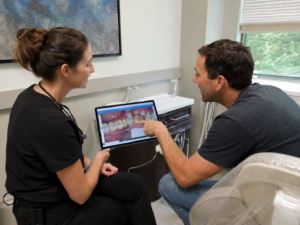
Minimally Invasive Does Not Mean Avoiding Necessary Treatment
One of the most important things to understand about minimally invasive dentistry is that it does not mean choosing the smallest possible procedure regardless of the problem.
Sometimes preventive care or continued monitoring may be appropriate. In another situation, decay, damage, or structural weakness may mean restorative treatment is necessary. Delaying appropriate care simply to avoid a procedure would not support the goal of preserving oral health.
Instead, a dentist may consider questions such as:
- Does this area need treatment now, or is monitoring appropriate?
- How much healthy tooth structure can reasonably be preserved?
- Which treatment options appropriately address the concern?
- How does the recommendation fit the patient’s overall oral health and goals?
A conservative approach can therefore include treatment when intervention is clinically appropriate. The goal is to find the right balance between avoiding unnecessary dentistry and treating genuine problems when they need attention.
Prevention Supports a Minimally Invasive Approach
Prevention is an important part of minimally invasive dentistry because identifying changes earlier may provide more information and more options for managing them.
Routine family dentistry and preventive care allow the dental team to monitor teeth, gums, existing dental work, and changes that may affect long-term oral health. What patients do between appointments also matters, including consistent brushing, flossing, and following individualized preventive recommendations.
Finding an area that is beginning to change does not automatically mean a restorative procedure is needed. Depending on the clinical findings, the dentist may recommend prevention, monitoring, or treatment.
The goal is to identify changes early enough that decisions can be based on the current clinical findings rather than symptoms alone.
Why Does Preserving Healthy Tooth Structure Matter?
When treatment is necessary, the dentist considers how much healthy natural tooth structure can appropriately be preserved.
That does not mean healthy structure can always remain completely untouched. A dentist may need access to an affected area or enough space to place a restoration that functions properly. The amount of preparation depends on the condition being treated and the type of treatment being considered.
A minimally invasive approach means avoiding unnecessary alteration of healthy structure while still doing what is required to treat the problem appropriately.
This philosophy may influence treatment planning for decay, damaged teeth, existing dental work, cosmetic concerns, and more complex dental needs. However, the best option is not automatically the procedure that changes the least tooth structure. It is the treatment that appropriately addresses the problem while respecting the healthy structure that remains.
How Can This Approach Influence Cosmetic Dentistry?
Minimally invasive thinking can also play a role when someone wants to change the appearance of their smile.
Cosmetic concerns vary from patient to patient. One person may be concerned about tooth position, while another may want to address shape, color, spacing, or several features at once. Because the goals and starting conditions are different, the appropriate treatment can also differ.
During cosmetic dentistry planning, the dentist can consider what the patient hopes to change, the health and structure of the teeth, and how different options may affect natural tooth structure.
For example, when tooth position is part of the concern, the dentist may discuss whether addressing alignment or changing tooth shape better fits the patient’s goals and clinical needs. The point is not that one approach is always more conservative than another. Treatment should be selected according to the individual situation.
Sometimes Monitoring Is the Appropriate Next Step
Not every finding during a dental examination requires an immediate procedure.
A dentist may identify an area that deserves attention but can appropriately be monitored for changes. Monitoring may involve comparing the area at future visits, watching for new symptoms or clinical changes, reinforcing preventive care, or obtaining additional diagnostic information when needed.
Monitoring should not be confused with ignoring a dental problem. It is an active clinical decision based on what the dentist finds at that point in time.
If the condition changes, the recommendation may change as well. This is another reason minimally invasive dentistry depends on individualized judgment rather than a rule that everything should either be treated immediately or left alone.
Personalized Treatment Planning Is Central to the Approach
Two people can have similar concerns and still receive different recommendations.
One patient may have more healthy tooth structure remaining. Another may have existing dental work, different bite forces, gum concerns, or other factors that influence treatment planning. Patients can also have different priorities regarding function, appearance, comfort, and long-term care.
A personalized plan may consider:
- Current oral health
- Tooth and gum condition
- Existing dental work
- Function and bite
- Preventive needs
- Patient goals and preferences
For patients with several interconnected concerns, this broader perspective can become especially important. A decision involving one tooth may affect treatment planned elsewhere in the mouth.
That is why minimally invasive dentistry fits naturally with comprehensive dental care. Preserving what is healthy often requires understanding how individual decisions fit into the health, appearance, and function of the mouth as a whole.
Patient Involvement Matters Too
Minimally invasive dentistry is not only about the procedure the dentist recommends. It also involves helping patients understand what is happening and why a particular approach may be appropriate.
Useful questions can include:
- What problem are we trying to address?
- Does it need treatment now?
- What options are available?
- How could each option affect healthy tooth structure?
- What are the advantages and limitations of the options?
Clear explanations give patients an opportunity to understand the reasoning behind treatment rather than feeling that decisions are simply being made for them.
Patient involvement and informed decision-making are important parts of personalized care at The Smile Architects. The goal is to help patients understand their options and feel comfortable participating in decisions about their oral health.
A Thoughtful Approach to Long-Term Dental Health
Minimally invasive dentistry does not mean avoiding treatment or always choosing the smallest procedure. It means approaching dental care thoughtfully, preserving healthy natural structure when appropriate, and recommending treatment based on what each patient actually needs.
For one person, that may mean preventive care and monitoring. Another patient may need restorative treatment, while someone considering a smile enhancement may have several possible approaches to discuss. More complex concerns may require a broader plan that considers how different treatment decisions relate to one another.
The common thread is individualized decision-making.
The Smile Architects combines preventive, cosmetic, family, and comprehensive dental care with personalized treatment planning and clear communication. The goal is not simply to do less dentistry. It is to provide the appropriate amount of care while preserving healthy structure whenever possible.
If you have questions about a recommended treatment or are considering changes to your smile, book an appointment with The Smile Architects to discuss your oral health, goals, and personalized treatment options.
Leave a Reply
You must be logged in to post a comment.