
How Do Clear Aligners Work? Step-by-Step Process to Straighten Teeth
Straightening your teeth no longer requires the noticeable metal brackets and wires often seen on students. While clear aligners have become the most popular discreet alternative to braces, the actual mechanics of how they move teeth remain a mystery to many patients. You might find it hard to believe that a thin piece of medical-grade plastic can exert enough force to physically shift your smile into a new position, especially if you are searching for a skilled dentist in Newport to guide the process.
At The Smile Architects, we believe that understanding the “how” behind your treatment leads to a more confident experience. Dr. Cooper and Dr. Charneski approach clear aligner therapy as a high-precision craft we call “Smile Architecture.” This philosophy ensures that your journey from our Newport office to your final result is built on a foundation of clinical expertise, natural aesthetics, and a bite that is designed to last. Whether you are a professional commuting along I-494 or a parent in Newport, you deserve to know exactly how this technology transforms your smile.
The Science of Tooth Movement: The Biological “Push”
At its simplest level, clear aligners work by applying controlled, gradual pressure to specific teeth. Unlike traditional braces that use brackets to pull teeth with wires, aligners use a “push” force. Each set of trays is designed to make tiny, planned movements of approximately 0.25 millimeters.
The success of your treatment depends on a biological process within your jawbone. Teeth are held in place by a periodontal ligament. When steady pressure is applied, the bone around the tooth root actually remodels. On the side being pushed, the bone breaks down to create space. On the opposite side, new bone grows in to fill the gap. This process happens gradually to protect the health of the tooth roots and ensure the new position is stable.
Because our lead doctors come from “dental families” with spouses who are also practicing dentists, we bring a unique 24/7 immersion in oral health to every case. We understand that this biological movement requires precise timing and expert oversight to be successful.
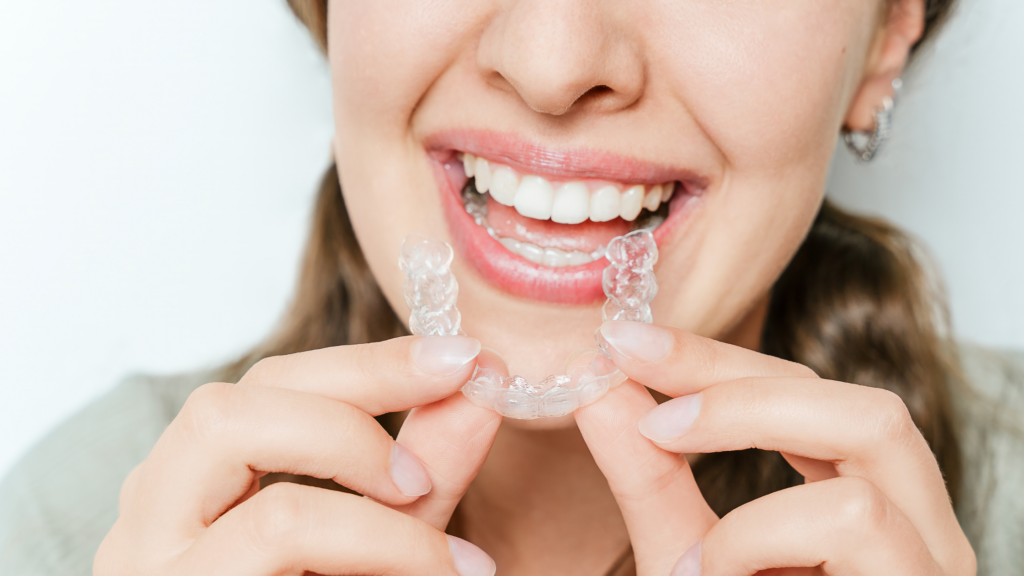
Step 1: The Initial Consultation and “Smile Architecture” Exam
The process begins at our quaint and comforting dental office in Newport on Hastings Ave. We believe in building deep, long-lasting relationships with our patients rather than running an impersonal clinic. During your exam, we look at several factors that go beyond just “straight teeth.”
- Facial Symmetry and Bite: We assess how your teeth support your lips and face shape, looking at crowding, spacing, overbites, and crossbites.
- Oral Health Foundation: We ensure your gums and teeth are healthy enough for movement. Active gum disease or untreated cavities must be addressed first because moving a tooth with an unstable foundation can cause permanent damage.
- Clinical Autonomy: Our treatment recommendations are based on your health needs, not insurance company limitations. We maintain strict independence to ensure you receive the best care possible for your specific biology.
Step 2: Digital Scans and Strategic Staging
Gone are the days of messy, uncomfortable putty impressions. We use state-of-the-art 3D digital scans to capture every detail of your teeth and bite. This high-precision model allows our “top-tier talent” to map out each movement with surgical accuracy.
The planning stage involves “staging.” We do not move every tooth at once. Often, we must move the back molars first to create “anchorage” or space before the front teeth can be aligned. We can show you a digital preview of your expected results before you even start, providing a clear roadmap for your transformation.
Step 3: Why Custom Trays and “Attachments” Are Necessary
Once the plan is finalized, your custom series of trays is produced. Each tray is shaped slightly differently to continue the movement from the previous stage. You might notice that your trays fit very snugly, especially when you start a new set. This tightness is the mechanical force needed to trigger the bone remodeling process.
For some movements, such as rotating a rounded tooth or moving a tooth vertically, the plastic alone needs extra “grip.” We may apply “attachments” to certain teeth. These are tiny, tooth-colored bumps made of dental composite. They act like handles, giving the aligner the leverage it needs to execute complex movements that plastic alone cannot achieve.
Step 4: The Daily Routine and Progress Monitoring
Once you start wearing your aligners, the biological work begins. Most patients switch to a new set of trays every one to two weeks. As you travel between South St. Paul and the Woodbury Retail Hubs, your aligners are working behind the scenes.
Consistency is the most important factor in your success. You must wear the trays for 20 to 22 hours per day. Our commitment to family dentistry means we understand the busy schedules of local households. If the trays are out for too long, the teeth can begin to drift back, which interrupts the bone remodeling and can cause the next tray in your series to not fit properly. This flexibility is a major benefit for busy families in Newport and St. Paul Park, provided the wear-time discipline is maintained.
Step 5: Finishing, Refinements, and Retention
We schedule regular check-ins to monitor your progress and ensure your teeth are “tracking” or following the digital plan. If a tooth is lagging behind, we can make adjustments. This attention to detail is what defines our standard of cosmetic dentistry.
Once the active phase is complete, we move to retention. Teeth have a natural “memory” and want to drift back toward their original spots, especially in the first few months after treatment. To prevent this, we provide custom retainers. These hold your teeth in their new positions while the surrounding bone fully stabilizes and hardens.
Frequently Asked Questions About Clear Aligners
How long does it take for clear aligners to start working?
Biologically, the “work” begins the moment you snap in your first tray. The initial pressure starts the cellular response in your periodontal ligament immediately. While you won’t see a visible difference in the mirror after day one, most patients begin to notice subtle changes in how their teeth fit together or how they floss within the first four to six weeks.
Why do some patients need attachments with clear aligners?
Think of attachments as “anchors” or “handles” for the plastic. Because teeth are naturally slick and often rounded, the plastic tray can sometimes slip rather than apply the necessary torque. By bonding a tiny, tooth-colored bump to the tooth, we give the aligner a flat surface to push against. This allows us to perform complex movements, like pulling a tooth downward or rotating a premolar, with the same precision as traditional braces.
What happens if you do not wear aligners enough?
When you remove your aligners, the pressure that keeps the bone in a state of “remodeling” stops. If the trays are out for several hours, the teeth can begin to shift back toward their old positions. If this happens repeatedly, the teeth will no longer “track” with the current tray, meaning the aligner will stop fitting correctly. This often requires us to backtrack to a previous tray or rescan the mouth entirely, which can add weeks or months to your treatment time.
Do teeth move back after clear aligner treatment?
Yes, teeth have a natural tendency to shift back to their original positions—a process called relapse. This is because the bone and ligaments around the teeth take significant time to “set” in their new arrangement. This is why retainers are a non-negotiable part of the process. We typically recommend full-time retainer wear initially, eventually transitioning to nightly wear to protect your new smile architecture permanently.
Do clear aligners work for everyone?
While clear aligners have become incredibly advanced, they are a tool, and every tool has its limits. Aligners are excellent for mild to moderate crowding, spacing, and some bite issues. However, severe skeletal discrepancies or extremely complex tooth rotations may still require traditional orthodontics or a combination of treatments. During your initial “Smile Architecture” exam, we will be honest about whether aligners are the most effective path for your unique health needs.
Making Expert Care Accessible in Newport
We believe that high-quality dentistry should be accessible to everyone in our community, including those in Inver Grove Heights and those commuting past the M Health Fairview Sports Center.
- Senior Savings: We offer a specific 5 percent savings for uninsured senior patients who pay in full at the time of service, making elite care accessible for those on fixed incomes.
- Financial Flexibility: We provide 3-month in-office financial arrangements to help patients without insurance coverage manage their treatment costs.
- Local Trust: Our office is located near Newport Elementary, offering a warm and relatable environment where patients are treated with the same standards we expect for our own households.
Find Out How Aligners Could Work for You
If you have been wondering how clear aligners could transform your smile, the first step is a professional evaluation. We invite you to visit our office or to schedule a consultation to see how our clinical expertise and personalized quality care can help you achieve a natural, long-lasting smile.
Leave a Reply
You must be logged in to post a comment.